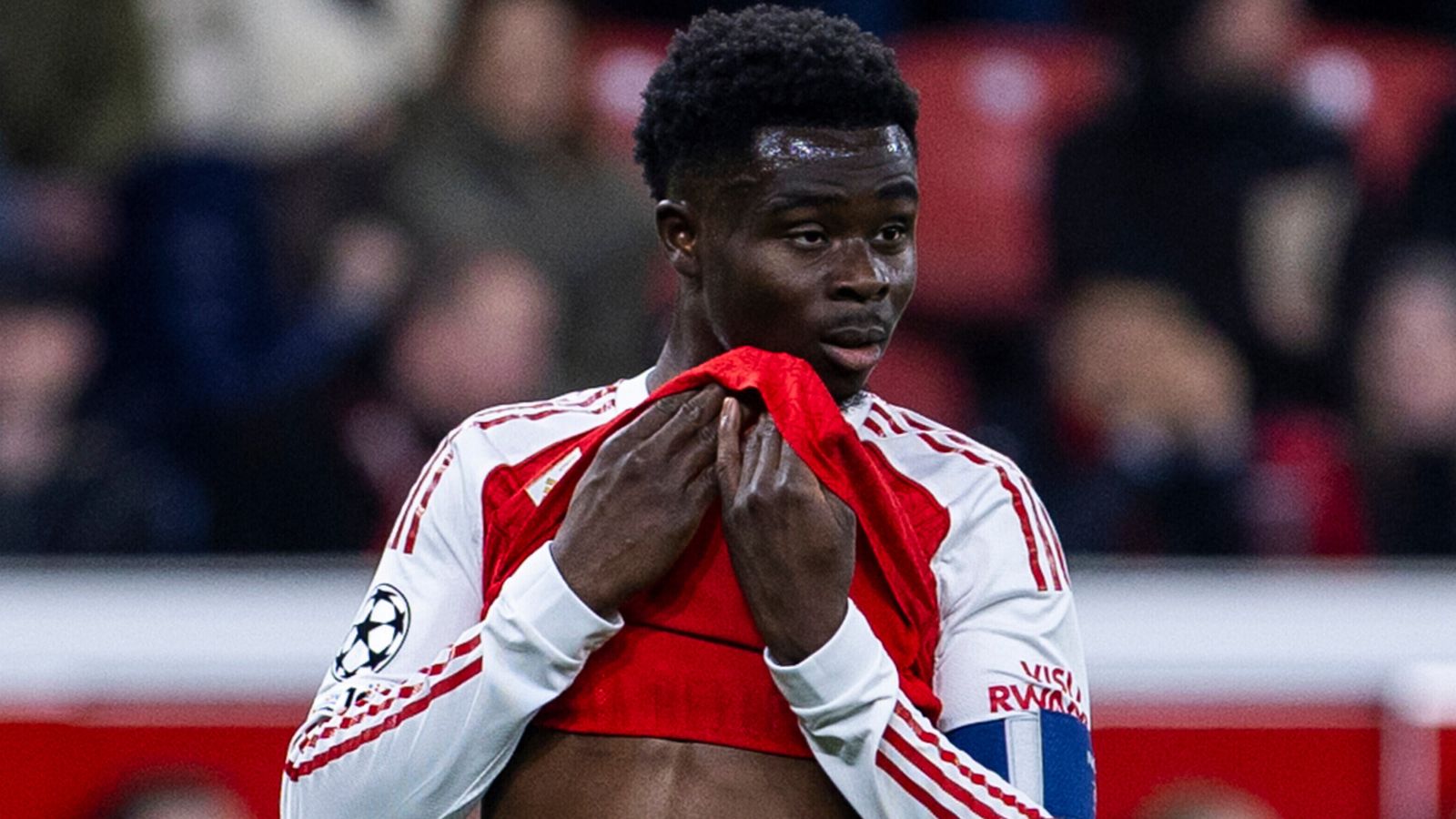
It is highly unusual to see Bukayo Saka's number come up as early as the 60th minute, especially in a game in which Arsenal need a goal. And yet it came as little surprise against Bayer Leverkusen. Their captain on the night had struggled.
For an hour at the BayArena, Saka was unable to find a way through on Arsenal's right-hand side, sometimes confronted by as many as three Bayer Leverkusen defenders. He only completed one of his four attempted dribbles. He only won two of his eight duels.
"I thought we needed something else," said Mikel Arteta afterwards. Saka was not alone among Arsenal's attacking players in finding it difficult, but his replacement, Noni Madueke, made an immediate impact, his directness ultimately winning the penalty.
"No surprise at all because that's his biggest quality," added Arteta in his press conference. "He's very brave at doing that and is a real threat. To have a player with that ability when you need him, and to step in in the manner that he did, big credit to him."
The competition for places is of course exactly what Arsenal wanted when they brought in Madueke. But Saka's subdued showing on Wednesday night comes as he struggles to meet the extremely high standards he has set in previous campaigns for Arsenal.
Saka's deflected strike against Brighton last week proved invaluable but it was only his second goal in 19 games. With nine goals and five assists across 39 appearances in all competitions, he is producing goal involvements at his lowest rate as an Arsenal starter.
His rate of productivity has in fact nearly halved from last season, when his campaign was interrupted by the hamstring tear he suffered in December. The injury required surgery and put Saka on unfamiliar ground, facing the first major setback of his career.
Arteta may reflect that Saka played too much in the years leading up to that. He was rarely rotated let alone substituted, his importance to the side too great. But it was obvious from his performances that he benefited from the rhythm and regularity.
Saka has of course recovered from the injury. Arsenal's conviction that he will get back to his best is clear in their decision to hand him a new contract making him their highest-paid player only last month. But finding the same rhythm has so far proved difficult.
Saka suffered another hamstring injury in only the second week of the season, forced to come off after scoring in a 5-0 win over Leeds. He had another spell out with a hip injury picked up during the warm-up against the same opponent in January.
In between the two, he was rotated in and out of the side, his workload carefully managed. A sensible approach, no doubt, but one which left Saka in the novel situation of not starting consistently.
Tracking data from GeniusIQ shows no clear evidence of a physical drop-off. Saka's top speed this season is roughly consistent with previous campaigns. He is actually making more sprints than last term, averaging 13.7 per 90 minutes up from 12.8.
But the dip in his output goes beyond goals and assists.
Saka is having fewer shots and creating fewer chances than last season in the Premier League. He is getting roughly as many touches of the ball but far fewer in the opposition box. His dribbles are slightly up but he is carrying the ball forward less.
It is of course important to note the context of this being an especially challenging season for the Premier League's attacking players. Open-play goals are down across the board. Deep blocks are prevalent. Space in the final third has been squeezed.
Perhaps most significantly, Saka is getting fewer opportunities to isolate his full-back. His one-on-ones in the Premier League have dropped by over 10 per cent, from 18.9 per 90 minutes last season to just 16.8 this term. Wednesday's game at the BayArena showed a European opponent adopting similar tactics.
It took Madueke, a winger who differs in style to Saka, unpredictable bordering on erratic, his patchy decision-making a stark contrast to Saka's clear thinking, to break the game open.
Having won the penalty for Kai Havertz's equaliser, Madueke has now made a direct contribution to a goal in six of his last nine appearances in all competitions as he shows signs of settling into his new surroundings. But Saka has had to adapt too.
His chemistry with Martin Odegaard has been hugely important to Arsenal's attack in recent seasons but the club captain was absent against Bayer Leverkusen. Injuries mean Saka and Odegaard have only started 16 out of 47 games together this season.
Saka is yet to develop a similar understanding with Eberechi Eze, or with Viktor Gyokeres compared to Havertz up front, and the same can be said of his relationship with right-back Jurrien Timber compared to Ben White, who is now out of favour but was arguably even more important in platforming the 24-year-old.
White's telepathy with Saka extended to how he passed to him, almost always putting Saka in a position to run onto it, rather than receive with his back to goal. "We just kind of know," . "I don't really understand why, but, when I look up, I know what he's going to be doing or where he's going to be."
While Timber, a natural centre-back, has improved offensively, in addition to adding greater defensive solidity, he does not seem as attuned as White to the needs of the player in front of him.
"I'm there to help him get into positions where he can do what he is so good at," added White, who has had injury problems of his own and only started six games with Saka this term.
The good news for Arsenal is that, as Saka tries to recapture his rhythm and build new connections, they do at least have a credible alternative in Madueke. He was their difference-maker at the BayArena. He is pushing for more involvement.
But helping their talisman, their most valued player and someone who has probably contributed more under Arteta than anyone else, get back towards his best should be a priority for the manager.